
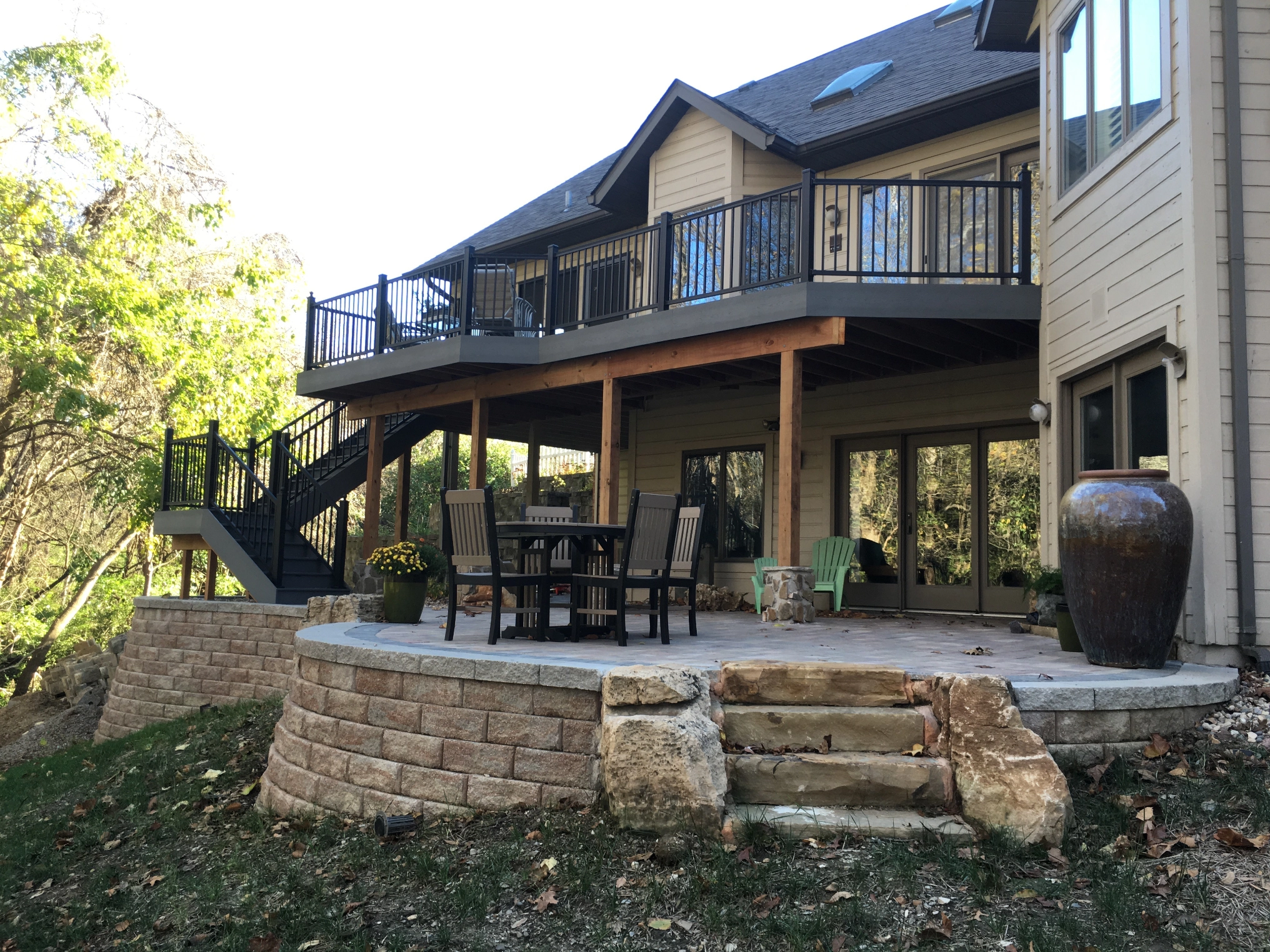
A deck is an elevated outdoor platform framed and attached to the house. It extends usable space when grade makes a patio impractical or when direct access from the home is needed.
Because it’s tied into the structure of the house and supported on footings, it carries structural implications beyond appearance. It’s architecture-level framing — just outside.
Deck height and connection to the house come first. Door thresholds, stair placement, and grade below influence layout decisions early. Stair location is influenced by what it's leading to. Do you want to get to the yard quickly or accommodate a patio? If you're wanting a patio underneath, under-deck drainage systems will make the deck feel like a roof.
Decks are considered permeable in case you're hitting your properties impermeable square footage limit. Decks are also a useful solution around sensitive trees because they avoid excavation and soil compaction under the drip line.
Material selection — composite versus wood — affects heat retention, maintenance, and long-term appearance. Decks also need to integrate with patios or walkways below, especially when the yard transitions from elevated to grade-level hardscape. We almost exclusively install composite decks because they last longer and take less to maintain.
Decks begin at the house connection. The ledger board is attached directly to the home’s framing using properly spaced lag screws, transferring load into the structure of the house. Flashing is installed carefully at this connection point to prevent moisture intrusion. Water behind a ledger doesn’t cause problems immediately — it causes problems years later — so that detail matters.
Piers are dug, formed and poured below the frost line — typically 30–34 inches in our region — to prevent seasonal movement. Concrete piers are sized appropriately for load and soil conditions. Posts are anchored with post bases that include a standoff plate, keeping wood separated from concrete and moisture.
Joist spacing is determined by the decking material requirements and span conditions. These are joists — not generic framing members — and they’re connected to both the ledger and the header, with support provided by a beam that rests on notched posts. That load path matters. The beam carries weight down into the posts and into the footings below.
Stair assemblies are tied structurally into the deck. The bottom of the stair requires a proper landing — either the patio below or a dedicated concrete landing — in accordance with building code. Stairs don’t simply rest on grade.
Decks carry live load, snow load, and connection load back into the house. When ledger attachment, flashing, joist layout, beam support, and footing depth are handled correctly, the deck feels solid underfoot and remains stable over time rather than loosening or settling.
Most composite deck projects begin around $45,000–$60,000 for a properly footed structure with standard stairs and mid-tier composite decking.
Mid-sized decks with larger footprints, upgraded railing systems, picture framing details, or multiple stair runs typically range from $60,000–$95,000 depending on height and layout.
Larger or elevated decks with switchback stairs, landings, under-deck drainage systems, or complex framing often fall between $95,000–$130,000+ depending on structural requirements and elevation.
Primary cost drivers include deck height, stair configuration, railing type, framing complexity, and whether under-deck drainage or usable space below is incorporated.
Design Considerations
Consider how high it sits above grade, how it connects to the home, and whether it feels elevated and private or open and expansive.
Common Pairings
Pergolas, lighting, pavilions, and fencing.
Pricing Factors
Typically $25k–$95k+. Structural requirements and finish materials drive scope.
Service hero background image only maybe vh67 and since the content overlaps it some making it the level
Similar look where it looks like a page that overlaps the hero some. background black. Contains a left side for a rich text element for the content, a section for service specific FAQ, and on the right side a "at a glance" card with a rich text element. We need to find a way to show projects that feature this service. I added service tags to the portfolio cms.
H1 within the second section. hero only has image. so H1 is still first words on the page.
Rich Text for:
"What is it"
intro description explaining the problems the service solves, situations where it makes sense. Functinoal improvements, clarifies use cases and the value it brings to a space.
"Design Considerations" + Oten paired with
this talks about how its used and design in a space. other elements to consider mixiing this with. typical site constraints, scale etc. Talk about the kinds of materials used.
"How it's built"
talk about what goes into building this element. This could be as simple as describing the trenching for the gas line or complicated as the steps to a pool build. Talk about the the base that makes it last, the framing that gives it shape, and the finishes that make details count. Things like utilities, code restrictions and typical permiting requirements.
"Pricing Factors"
Talk about typical pricing ranges, what conditions affect the price more or less than others. Things that people "think is expensive but isnt" and "what peopled dont think is expensive but is." Scale obviously impacts price but so does installation complexity. talk about what that complexity looks like for each service.
"Service FAQ"
a service specific faq based on the faq cms filtered to the service. include the featured faqs at the end. I plan to have 2-3 featured ones about getting started.
"At A Glance"
floating card on the right
- Considerations: 2-3 sentences about its value, use in designs, and pairings.
- Pricing: 2 ranges with descriptions
- Featured projects: Is there a way to make a mini slider with the project name? Is that too much and just list 3-4 project names with the arrow icon?
- CTA to portfolio & get Started
"Photos of Service"
Condense the current 3 photos into a multi photo
"Related projects"
Some kind of ribon or grid showing related projects. The projects cms have a multi-picklist to tag services used on that project and can be used to filter matching projects here. The challenge


.webp)