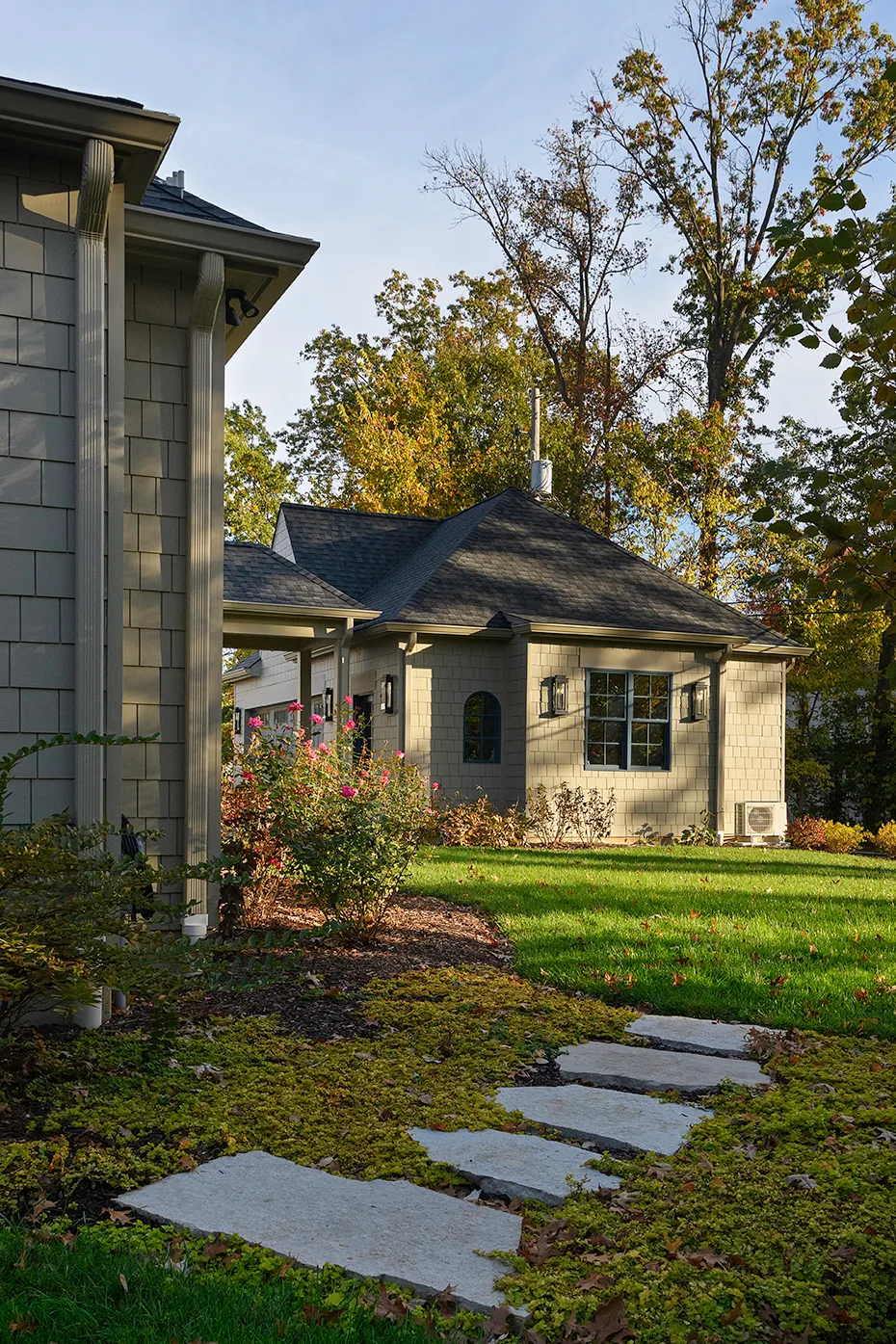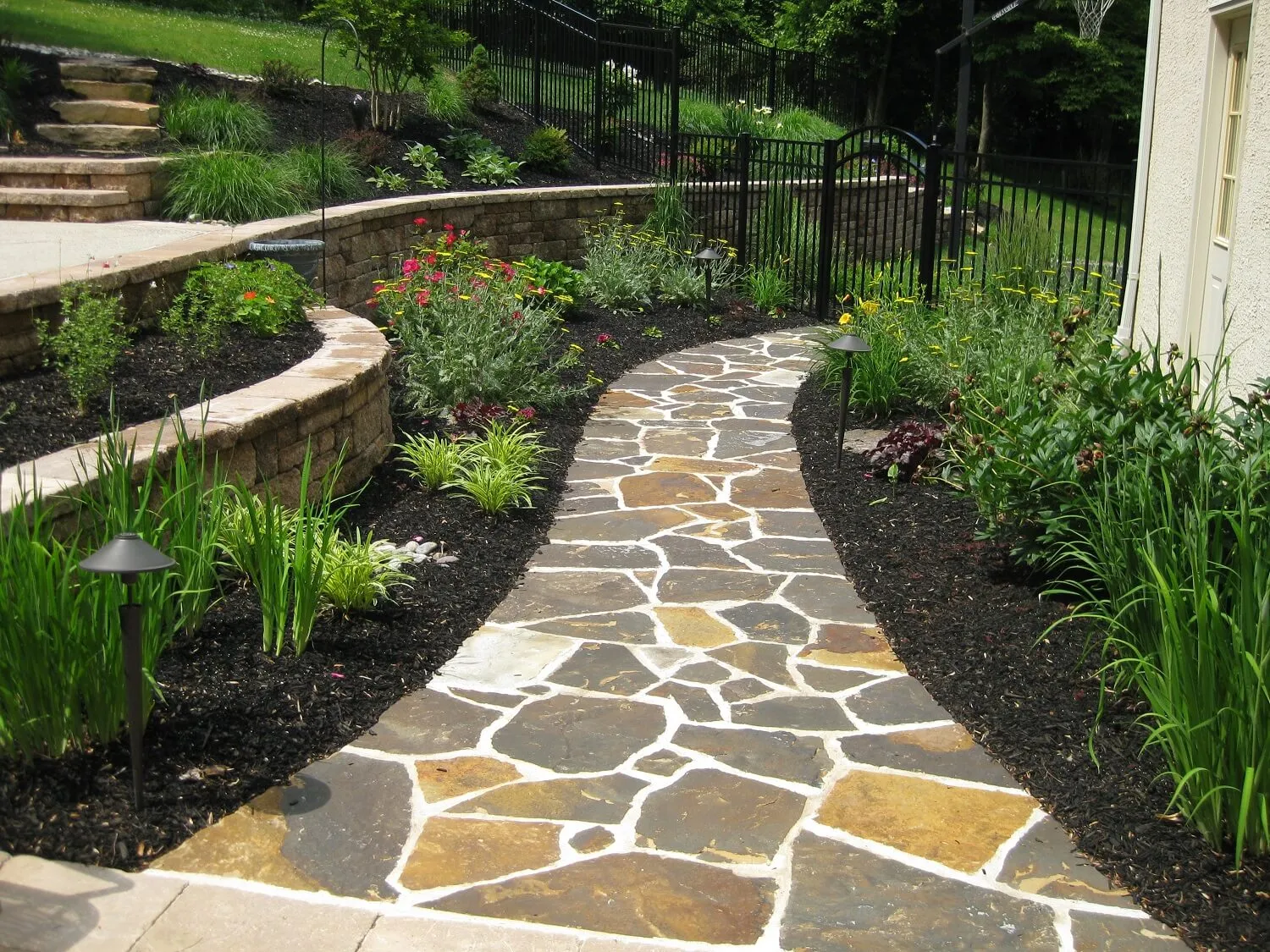

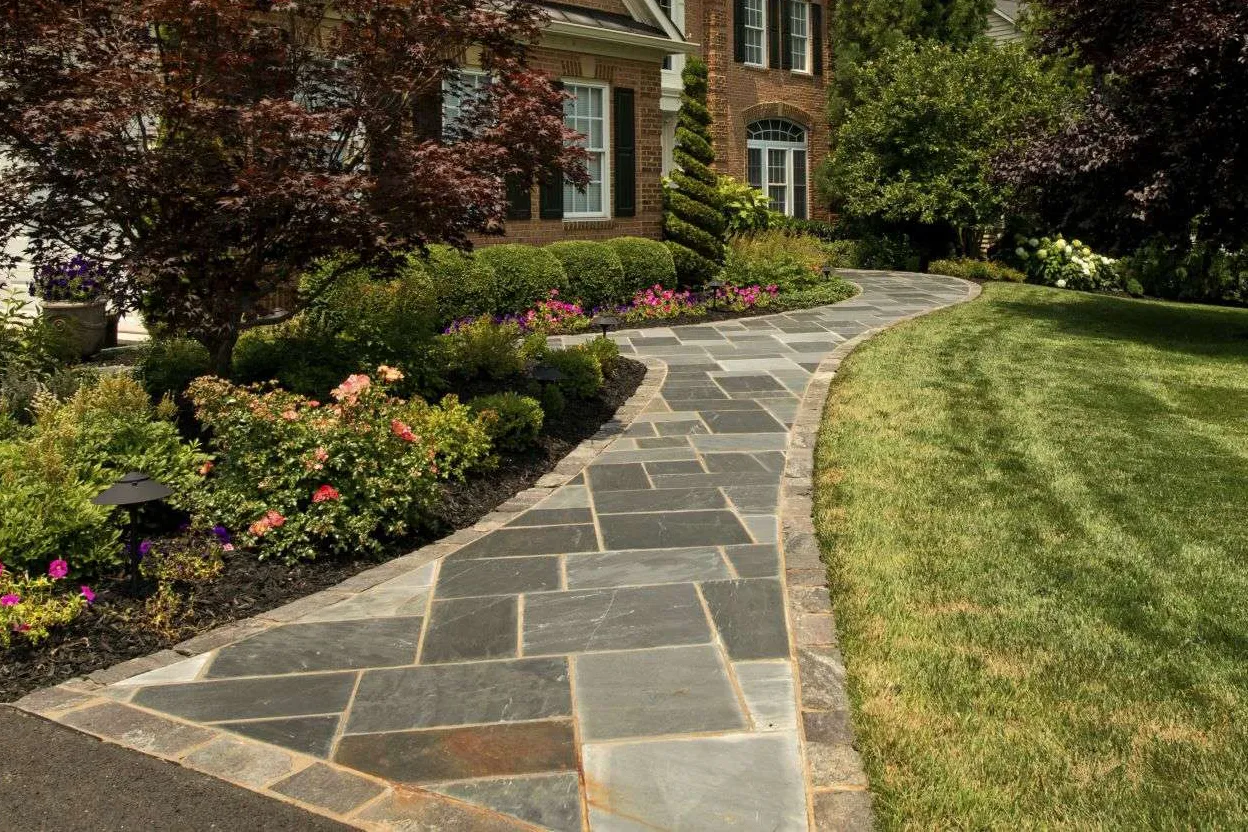
Flagstone walkways create informal, natural paths through a property. They’re often installed as stepper paths — individual stones set into turf, gravel, or groundcover — or as fixed and masoned side walks.
Flagstone works best when it feels natural to the property. In historic St. Louis neighborhoods, irregular stone can complement older masonry and softer landscape edges.
Flagstone can be installed as a full mortared walkway for high-traffic use, or as a stepping stone path for softer, more informal transitions.
Material tone should complement surrounding textures — landscape bed material, house siding or cladding, and other stone elements — so the walkway feels integrated rather than applied. Contrast here is valuable. Unity > uniformity.
Flagstone walkways are installed using one of two primary methods: set stone on concrete or stepper-style paths on compacted base. Both use natural stone, but the structural support beneath them is different.
For set stone walkways, we excavate and pour a concrete base. The flagstone is then set and secured on that slab so the surface remains stable long term. Because natural stone varies in thickness, each piece is adjusted during installation to maintain a consistent walking surface. Thicker stones are seated properly; thinner stones are built up so the finished elevation remains even. Joints are filled according to the design intent, and the concrete base prevents long-term shifting.
For stepper-style paths, individual stones are spaced intentionally to match natural stride. These are installed on compacted aggregate beneath each stone rather than a continuous slab. Even though the look is informal, each piece still requires stable support. Base material is compacted beneath every stone to prevent rocking or seasonal settling.
In both systems, thickness variation is managed during installation — not ignored. Most long-term issues occur when stone is set directly on soil or when irregular pieces aren’t supported evenly. When the base is prepared correctly and each stone is placed deliberately, the walkway remains stable and aligned over time.
Simple stepping stone paths typically begin around $2,000–$4,000 depending on length and stone selection.
More defined stepping stone paths with excavation, base preparation, and edging commonly range from $5,000–$12,000.
Full mortared flagstone walkways generally fall between $20,000–$35,000+ depending on length, access constraints, grading requirements, and stone thickness.
Primary cost drivers include pathway length, stone type and thickness, base preparation depth, site access, and whether the system is dry-set or mortared.
Design Considerations
Consider how the path directs movement, whether it feels formal or organic, and how it transitions between spaces.
Common Pairings
Retaining walls, landscape beds, landscape lighting, putting greens, and entry patios.
Pricing Factors
Typically $8k–$35k+. Stone type, excavation depth, and site access shape pricing.
Service hero background image only maybe vh67 and since the content overlaps it some making it the level
Similar look where it looks like a page that overlaps the hero some. background black. Contains a left side for a rich text element for the content, a section for service specific FAQ, and on the right side a "at a glance" card with a rich text element. We need to find a way to show projects that feature this service. I added service tags to the portfolio cms.
H1 within the second section. hero only has image. so H1 is still first words on the page.
Rich Text for:
"What is it"
intro description explaining the problems the service solves, situations where it makes sense. Functinoal improvements, clarifies use cases and the value it brings to a space.
"Design Considerations" + Oten paired with
this talks about how its used and design in a space. other elements to consider mixiing this with. typical site constraints, scale etc. Talk about the kinds of materials used.
"How it's built"
talk about what goes into building this element. This could be as simple as describing the trenching for the gas line or complicated as the steps to a pool build. Talk about the the base that makes it last, the framing that gives it shape, and the finishes that make details count. Things like utilities, code restrictions and typical permiting requirements.
"Pricing Factors"
Talk about typical pricing ranges, what conditions affect the price more or less than others. Things that people "think is expensive but isnt" and "what peopled dont think is expensive but is." Scale obviously impacts price but so does installation complexity. talk about what that complexity looks like for each service.
"Service FAQ"
a service specific faq based on the faq cms filtered to the service. include the featured faqs at the end. I plan to have 2-3 featured ones about getting started.
"At A Glance"
floating card on the right
- Considerations: 2-3 sentences about its value, use in designs, and pairings.
- Pricing: 2 ranges with descriptions
- Featured projects: Is there a way to make a mini slider with the project name? Is that too much and just list 3-4 project names with the arrow icon?
- CTA to portfolio & get Started
"Photos of Service"
Condense the current 3 photos into a multi photo
"Related projects"
Some kind of ribon or grid showing related projects. The projects cms have a multi-picklist to tag services used on that project and can be used to filter matching projects here. The challenge